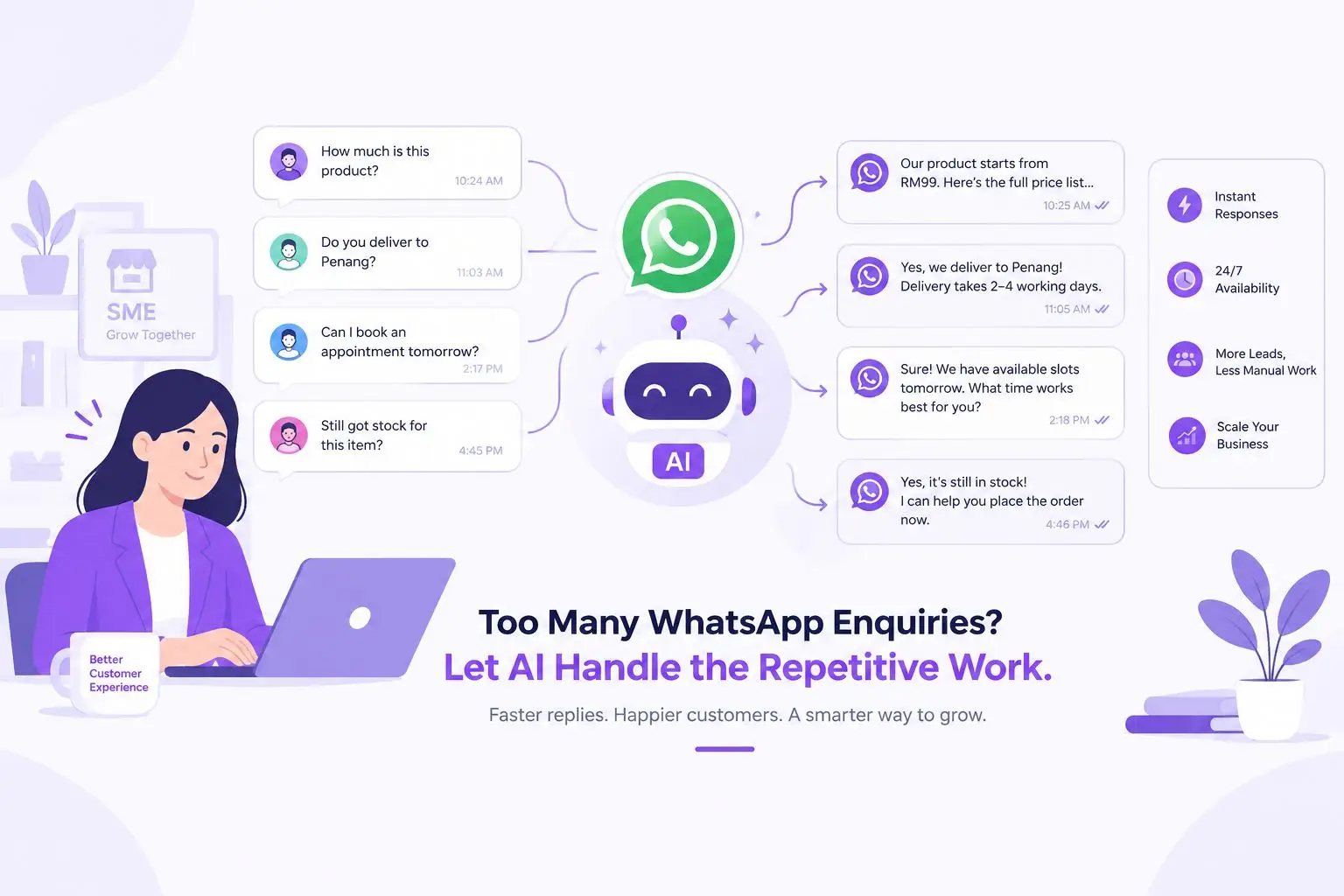
For many Malaysian businesses, WhatsApp is more than just a messaging app. It has become an important channel for talking to customers, following up with leads, taking orders, booking appointments, and closing sales.
Whether you run an eCommerce store, property agency, clinic, salon, service business or B2B company, there is a good chance that WhatsApp is already part of your daily business operations.
But there is one major challenge: “The more your business grows, the more WhatsApp conversations you need to handle.”
And this is where a WhatsApp AI chatbot can help.
Why WhatsApp Matters for Malaysian SMEs
Customers today expect businesses to respond quickly.
Someone might discover your business through a Meta ad, visit your website, and immediately send you a WhatsApp message asking:
“Hi, how much is this?”
“Do you have appointment slot for tomorrow?”
“Can deliver to Penang?”
These are potential customers who are already showing interest.
If you or your team takes several hours to reply, there is a chance that the customer has already moved on, contacted another business, or bought from your competitor.
Speed matters when you’re handling online leads.
Unlike personal WhatsApp conversations, business WhatsApp messages can directly affect your sales.
The Same Questions Keep Coming Back
If you manage customer enquiries manually, you probably see the same questions every day.
Customers may constantly ask about:
- Pricing
- Product availability
- Services
- Business location
- Delivery areas
- Shipping fees
- Opening hours
- Appointment availability
- Property details
- Promotions
You probably already have the answers saved in your phone’s Notes app, a Google Doc, or even a private WhatsApp conversation.
So every time someone asks, you will need to:
Find the answer → Copy → Paste → Send → Repeat.
One conversation is easy. But when your business receives 50, 100, or even hundreds of enquiries every day, these repetitive tasks can take up a huge amount of your time.
What Happens When You Scale Your Business?
Imagine you’re running Meta Ads and the campaign is performing well. After a period of time, you decided to increase your advertising budget.
More advertising brings more leads. More leads bring more WhatsApp conversations.
And suddenly, your customer service team is struggling to keep up. You may need to hire additional staff just to maintain your response time.
Your existing customer service team may also become overwhelmed by repetitive questions, leaving less time for important conversations such as serious buyers, complaints, negotiations, or high-value leads.
This is one of the biggest reasons SMEs are looking into WhatsApp AI automation.
Instead of increasing manpower every time your enquiry volume increases, you can automate part of the workload.
What Is a WhatsApp AI Chatbot?
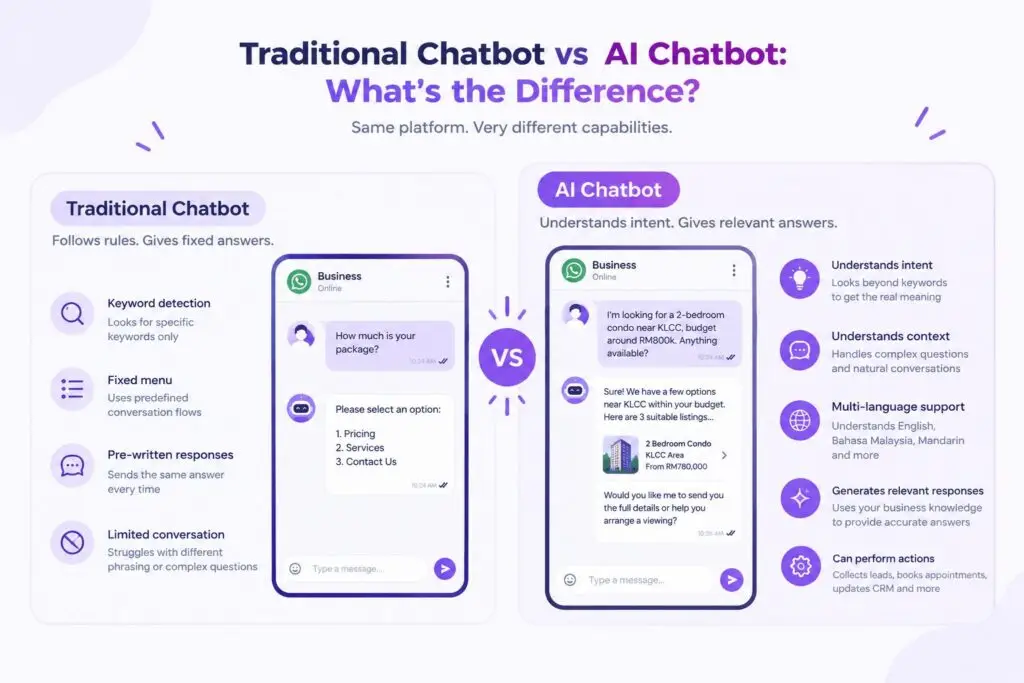
A WhatsApp AI chatbot is an AI-powered assistant that can communicate with customers through WhatsApp.
But it is very different from the traditional keywords-based WhatsApp chatbot Malaysia businesses have used for years before.
Traditional chatbots generally work by detecting keywords and following predefined conversation flows.
For example:
Customer: “How much is your package?”
Traditional chatbot:
“Please select an option:
- Pricing
- Services
- Contact Us”
This can work for simple enquiries, but real customers don’t always communicate in predictable ways.
They might ask in these way:
- “How much?”
- “What’s the price?”
- “Can share your package rates?”
- “How much I need to pay?”
- “多少钱?”
- “Berapa harga?”
An AI can eventually understand that these messages are all asking about pricing, even though the message isn’t hitting certain keywords. That’s the true differences between traditional chatbot and AI chatbot.
AI That Can Do More Than FAQs
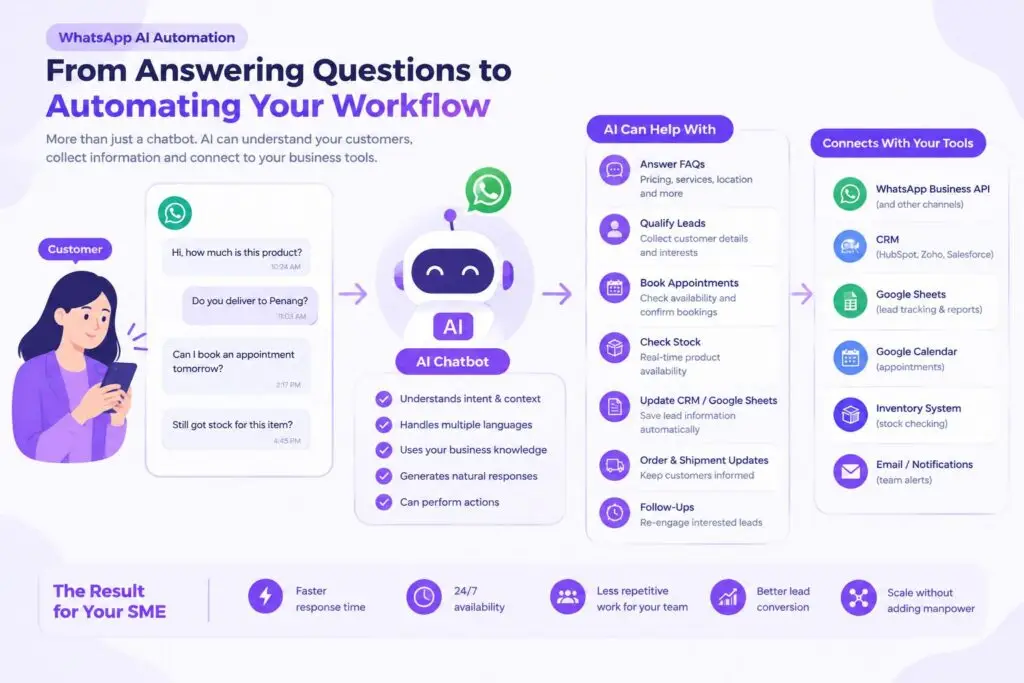
This is where WhatsApp AI automation becomes much more powerful. AI doesn’t have to stop after answering a question. It can also perform tasks that your customer service team currently handles manually.
For example, if a customer wants to book an appointment, the AI can collect:
- Name
- Phone number
- Preferred date & time
- Service required
- Special requirements
The information can then be sent to your CRM, Google Sheets, booking system, or internal workflow.
Other possible automations including:
- Lead Qualification: Ask potential customers a few questions and identify whether they’re a suitable lead before passing them to your sales team.
- CRM Updates: Automatically record customer details and enquiry information in your CRM.
- Google Sheets: Send new leads directly into a Google Sheet for your sales team to monitor.
- Appointment Booking: Collect booking requirements and help customers through the appointment process.
- Stock Checking: Connect with your inventory system so customers can ask whether a product is available.
- Order & Shipment Updates: Automatically provide customers with information about their orders or deliveries.
- Follow-Ups: Follow up with leads who showed interest but didn’t complete their purchase or booking.
This means your AI isn’t simply chatting with customers. It can become part of your actual business workflow.
Is a WhatsApp AI Chatbot Right for Your Business?
A WhatsApp AI chatbot for SMEs can be particularly useful if your business:
- Receives many WhatsApp enquiries
- Runs Meta Ads
- Answers the same questions repeatedly
- Has a small customer service team
- Handles appointment bookings
- Receives online orders
- Needs to follow up with leads
- Wants to provide after-hours support
- Uses WhatsApp as an important sales channel
If your team is already spending hours everyday copying and pasting the same answers, that’s a good sign that part of your process could be automated.
You don’t need to automate your entire business overnight. A good starting point is to identify the questions and tasks your team handles repeatedly.
Look at your WhatsApp conversations and ask:
What are customers asking most often?
Then prepare:
What does my staff do after answering those questions?
Perhaps they need to collect customer details, update a spreadsheet, check stock, notify a salesperson, or schedule a follow-up.
These are the areas where AI automation can potentially create the biggest impact.
Want to See What AI Can Automate for Your Business?
At AI-yo, we help SMEs automate customer conversations and business workflows across WhatsApp and other messaging channels.
From answering FAQs and qualifying leads to booking appointments, collecting customer information and connecting with your existing tools, we can help you identify what should be automated in your current workflow.
Talk to AI-yo and see what you can automate today.
Want results like this for your business?
Book a free demo and see how AI-yo can transform your customer experience.
💬 Book a Free Demo

Leave a Comment
Be the first to share your thoughts on this article.