If your business uses an AI chatbot, AI sales agent, or automated customer service system, there’s an important OpenAI update you shouldn’t ignore.
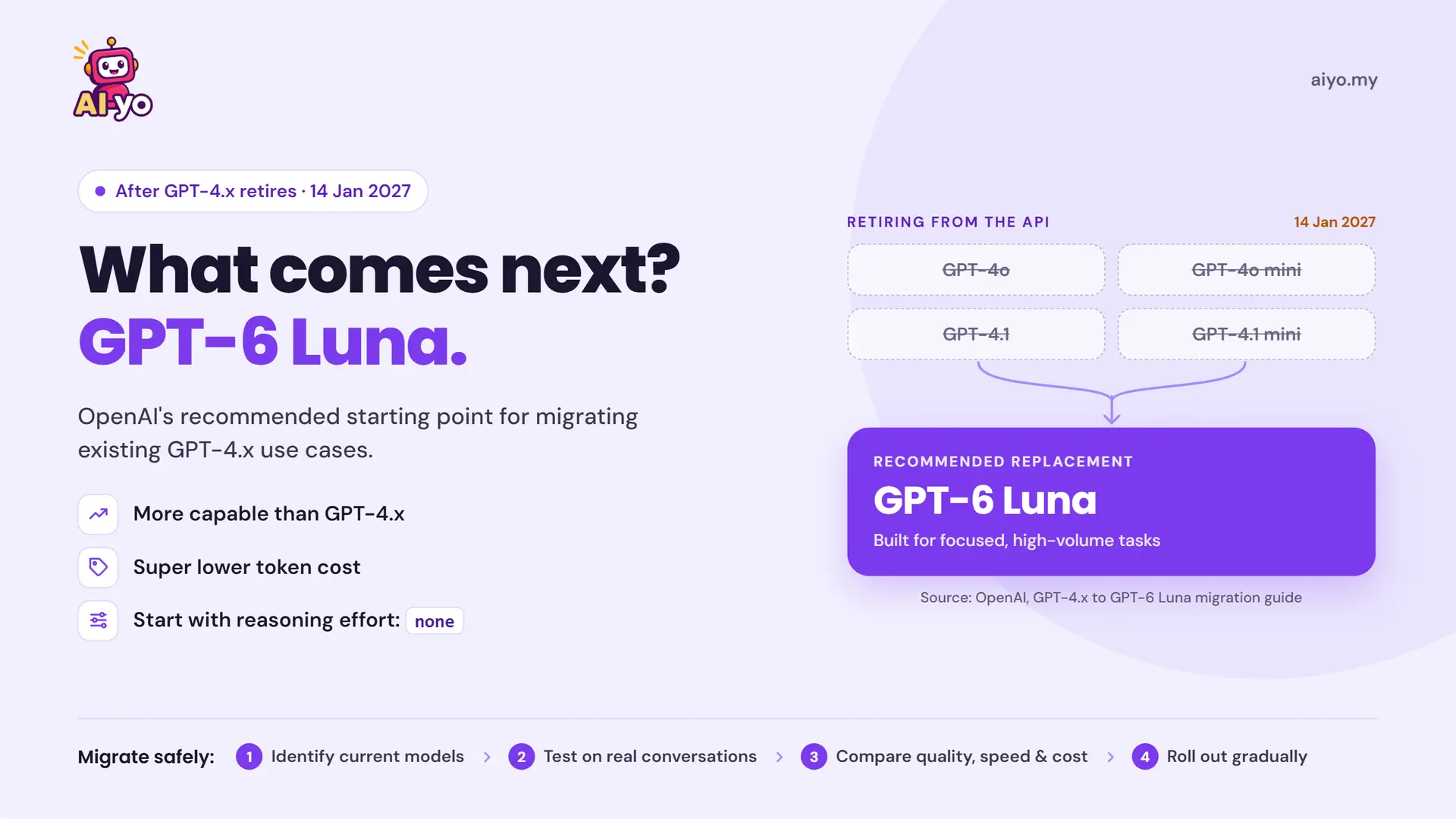
OpenAI has announced that GPT-4o, GPT-4o mini, GPT-4.1, and GPT-4.1 mini will be retired on 14 January 2027.
At AI-yo, I look at AI technology from a practical business perspective. How much does it cost? How quickly does it respond? Can it handle more business information? And, most importantly, can it complete the tasks we need it to do?
Let’s compare GPT-4o and GPT-6 Luna using actual published numbers.
1. GPT-4o vs GPT-6 Luna: The Numbers
The most immediately useful comparison for business owners is pricing and context capacity.
According to OpenAI’s official API documentation, GPT-4o costs US$2.50 per million input tokens and US$10 per million output tokens at standard rates. GPT-6 Luna costs US$0.10 per million input tokens and US$0.50 per million output tokens at standard short-context rates.
Here’s the comparison using OpenAI’s published specifications.
| Metric | GPT-4o | GPT-6 Luna |
|---|---|---|
| Input price per 1M tokens | US$2.50 | US$0.10 |
| Output price per 1M tokens | US$10.00 | US$0.50 |
| Context window | 128,000 tokens | 1,050,000 tokens |
GPT-6 Luna’s listed input-token price is 96% lower than GPT-4o’s, while its output-token price is 95% lower.
However, lower pricing doesn’t automatically mean lower total costs for every application. Actual spending depends on token consumption, reasoning settings, caching, and the way your AI system is designed.
2. How Much Could Your Business Save?
Imagine your business uses an AI agent to answer customer enquiries, qualify leads, and follow up with potential customers. For illustration, let’s assume your AI processes 10 million input tokens and generates 2 million output tokens each month.
Using the official standard short-context API prices:
| Monthly API usage | GPT-4o | GPT-6 Luna |
|---|---|---|
| 10M input tokens | US$25.00 | US$1.00 |
| 2M output tokens | US$20.00 | US$1.00 |
| Total monthly token cost | US$45.00 | US$2.00 |
| Estimated annual token cost | US$540.00 | US$24.00 |
That’s a potential difference of $43 per month, or $516 per year, at this example usage level.
The calculation assumes identical token usage and excludes other charges. It is a pricing illustration, not a guarantee that your business will save the same amount after migration.
For businesses processing large volumes of customer conversations, though, it’s worth evaluating how the new pricing could affect operating costs.
3. A Larger Context Window: What Does 1 Million Tokens Actually Mean?
Another major difference is context capacity. GPT-4o has a 128,000-token context window, while GPT-6 Luna supports up to 1,050,000 tokens. That’s approximately 8.2 times the context capacity.
Why should a business owner care?
Imagine an e-commerce business using an AI agent to answer product questions. The AI may need access to product information, company policies, customer conversation history, and order details.
A larger context window gives developers more room to supply information within a request. This can be useful for applications involving long documents, extensive instructions, or complex workflows.
However, a larger context window doesn’t mean you should put your entire business database into every AI request. Good information retrieval, clear instructions, and appropriate data handling still matter.
For most businesses, the goal is to provide the AI with the right information at the right time, rather than simply giving it more information.
4. What Do OpenAI's Official Benchmarks Tell Us?
Pricing tells us how much a model costs to use. Benchmarks help us understand how a model performs on specific tasks.
OpenAI has published GPT-6 Luna evaluation results in its official launch announcement. Two useful examples are professional workflow automation and software engineering.
| Benchmark | Official GPT-6 Luna Result | What It Means for Businesses |
|---|---|---|
| AutomationBench | 5.4 percentage-point improvement over its predecessor, with 58% lower cost per task at high reasoning effort. | Potentially better cost efficiency when completing multi-step business workflows across applications. |
| DeepSWE v1.1 | 66.6% at maximum reasoning effort. | Demonstrates capability on complex software-engineering tasks, rather than directly measuring customer-service performance. |
Source: OpenAI's official GPT-6 Sol and Luna announcement. These results are not direct GPT-4o versus GPT-6 Luna comparisons. Results depend on the evaluation and reasoning configuration.
5. Does This Mean GPT-6 Luna Is Always Better Than GPT-4o?
Not necessarily. OpenAI recommends GPT-6 Luna as a starting point for migrating existing GPT-4.x applications, and its documentation describes Luna as a cost-efficient model for focused, high-volume tasks.
But no published benchmark can guarantee that a particular AI application will perform better immediately after a model switch.
Consider an AI sales agent for a solar company. A customer asks about installing solar panels. The AI needs to collect the customer’s monthly electricity bill, property type, location, and contact details before arranging a site visit.
The system must do more than generate a natural-sounding answer. It needs to follow the correct sequence, collect the required information, and trigger the appropriate action.
After changing models, I would test questions such as:
- Does the AI follow the correct lead-qualification process?
- Does it collect all the required customer details?
- Does it use the correct information from the business’s knowledge base?
- Does it trigger the right booking, notification, or CRM action
- Does it maintain acceptable response quality and speed?
If the new model passes these tests at a lower cost, the migration becomes a meaningful business improvement rather than simply a technical upgrade.
6. How I Would Prepare for the January 2027 Deadline
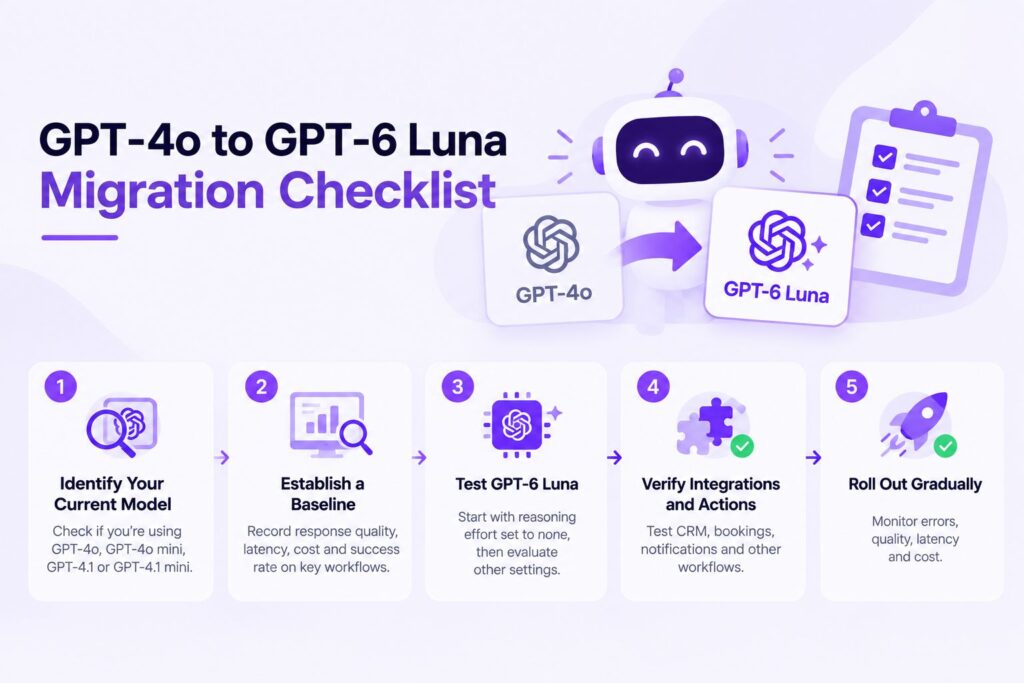
If your business currently relies on one of the affected models, I wouldn’t wait until January to start planning. Here’s the approach I would take.
Step 1: Identify your current model
Check whether your chatbot platform or custom AI application uses GPT-4o, GPT-4o mini, GPT-4.1, or GPT-4.1 mini.
If you’re using a third-party platform, ask the provider whether it will handle the migration.
Step 2: Establish a baseline
Collect representative customer questions and record your current system’s response quality, latency, cost, and success rate on important workflows.
Step 3: Test GPT-6 Luna
OpenAI recommends starting with reasoning effort set to none for migration testing, then evaluating other settings if necessary.
Compare the results against your existing system instead of assuming the default configuration will be optimal.
Step 4: Test integrations and automated actions
Verify that lead collection, appointment booking, inventory checks, CRM updates, and notifications still work correctly.
Step 5: Roll out gradually
Where possible, test in a staging environment or begin with a limited share of production traffic. Monitor errors, quality, latency, and cost before completing the migration.
You can read the official migration instructions here:
Final Thoughts: Focus on What AI Can Do for Your Business
The retirement of GPT-4o is a reminder that AI technology evolves quickly.
GPT-6 Luna offers substantially lower listed token prices, a larger context window, and encouraging results on OpenAI’s published evaluations. For many high-volume applications, it’s worth testing as a replacement.
But I wouldn’t choose a model based on price or benchmark scores alone. I’d look at whether it can reliably support the actual workflows my business depends on.
At AI-yo, that’s how I approach AI solutions. I don’t believe businesses should simply receive a chatbot template and be left to figure everything out themselves.
My focus is on understanding each business’s needs, building and configuring a custom AI agent, connecting relevant systems, testing its behaviour, and refining it as needed. Whether you want to automate customer enquiries, qualify sales leads, arrange appointments, or connect AI with your existing business systems, the objective is to make AI useful in day-to-day operations.
An AI agent should do more than answer questions. It should help move the conversation forward.
Want to explore what an AI agent could do for your business? Book a free 1-to-1 demo below with our team to see a practical use case tailored to your business.
Want results like this for your business?
Book a free demo and see how AI-yo can transform your customer experience.
💬 Book a Free Demo
Leave a Comment
Be the first to share your thoughts on this article.