And why businesses that don’t will be left behind — not by their competitors, but by their own operational ceilings.
Let me tell you something I’ve observed while building and deploying AI systems for businesses across different industries over the past few years. The companies quietly pulling ahead right now aren’t necessarily spending more on ads or hiring faster. They’re doing something far simpler and far more disruptive.
They’re adding AI Employees to their teams.
Not replacing their human staff. Not launching some complex digital transformation project that takes 18 months and a six-figure IT budget. They’re deploying AI Agents, the always-on workers that slot right into their existing business operations. No setup fee. No hidden fees. No contract binding. And critically, zero IT skills required.
The Definition of "AI Employee"
First, let’s define what an “AI Employee” actually is. I want to be precise here, because the term gets mentioned everywhere nowadays. An AI Employee or AI Agent, as they’re often called in the technical community, is not a simple chatbot that spits out canned responses. It’s not a FAQ widget. It is a custom-made digital worker powered by a large language model, trained on your business context, and connected to your workflows.
In practical terms, a well-configured AI Employee can:
- Respond to customer inquiries with full brand voice consistency, 24 hours a day
- Auto tag and categorize incoming conversations and routing them to the right department or human agent instantly
- Collect customer information and build your database without a single manual data-entry task
- Send appointment reminders and follow-up messages automatically
- Generate auto quotations based on customer inputs, no salesperson required for the first touchpoint
- Collect service and product feedback post-interaction
- Assign conversations to the right branch or agent based on context
- Engage with Facebook Live comments in real-time, capturing leads that would otherwise scroll past
In short, it handles the repetitive, high-volume, time-sensitive communication work that quietly consumes enormous chunks of your team’s day.

The Emotional Variable
Here’s something every business owner knows but rarely says out loud: your customer-facing staff are human, and humans have bad days.
A customer service rep who just handled three aggressive callers in a row is not going to bring the same energy to caller number four. A sales agent rushing through the lunch hour might miss a qualifying detail in a lead’s message. Someone burnt out from managing a hundred WhatsApp conversations a day will eventually start cutting corners either using shorter replies, delayed follow-ups or occasional tone slips.
This isn’t a criticism of your team, It’s biology. It’s the reality of managing a human workforce in high-volume and high-repetition environments.
An AI Employee doesn't have bad days.
It delivers the same measured tone, the same brand voice, the same level of patience whether it’s the first conversation of the day or the 101st; at 9am on a Monday or 3am on a Sunday. After a product launch that tripled your inquiry volume overnight, or during a quiet week in off-season.
For brands where customer experience is competitive, this consistency is genuinely transformative. You stop worrying about whether today’s shift is going to result in a bad Google review.

The Infinite Scale Problem
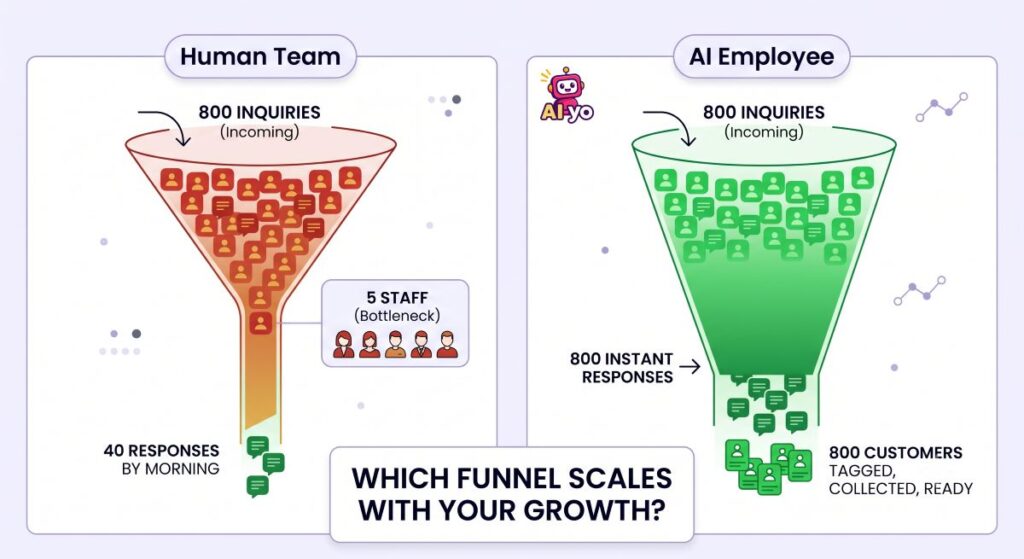
Picture this scenario: you run a flash sale. You post it at midnight because that’s when your audience is most active. Within 45 minutes, 800 people are sending messages asking about stock availability, delivery timelines, and whether the discount applies to bundles.
What happens to those messages with a human team? The morning shift arrives at 9am to find a backlog. By the time responses go out, the buying impulse has cooled. Some customers have already purchased from a competitor who replied faster. Others have shared their frustration on social media.
Now run the same scenario with an AI Employee in place:
- Every inquiry receives an immediate, personalised response regardless of volume
- Customer information is collected and tagged automatically
- An auto quotation is generated for relevant product queries within seconds
- Your human team wakes up the next morning to a clean, categorized lead list, ready to ship, not to reply.
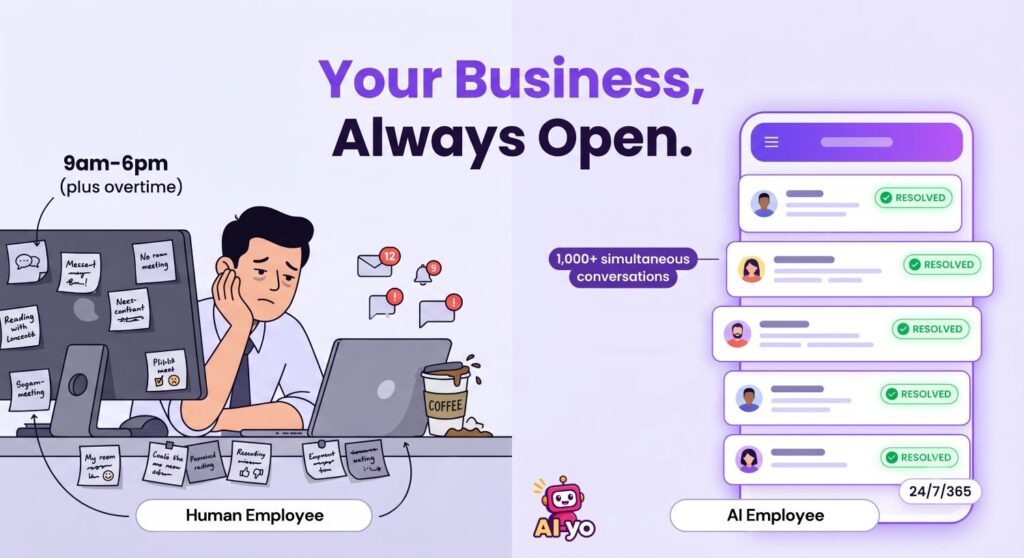
This is what I mean by the infinite scale advantage. An AI Worker doesn’t take a lunch break. It doesn’t need OT pay during peak season. It can handle 1,000 simultaneous conversations without a single lead going dark and it replies with the same quality among all conversations.
Zero Resignation Risk
I’ve spoken to business owners who’ve built genuinely impressive customer service operations with detailed SOPs, trained staff, strong processes. But having a key team member resign and watch three months of institutional knowledge walk out the door with them.
The cost is rarely discussed in full and it’s not just the recruitment fee or the gap period.
- The weeks it takes to get a replacement up to speed on your products, pricing, and tone
- The errors made during the learning curve such as the miscommunications, the missed upsells, the customer friction, lost track on old customer
- The morale drags on the remaining team who cover the gap
- The lost leads who encounter a slower, less informed response and simply go elsewhere
An AI Employee retains everything. Every product update you feed it, every conversation tone you train it on, every workflow automation you configure. There’s no resignation letter. There’s no counter-offer negotiation. There’s no two-week handover period where things slip.
When your AI Worker is set up correctly, it becomes a living record of your best customer-handling practices which always available, never degrading, and always deployable.
Side-by-Side: Human Employee vs. AI Employee
Let’s put this into concrete terms. This isn’t about replacing people, it’s about understanding where an AI Agent adds irreplaceable value:
| Human Employee | AI Employee (AI Agent) |
|---|---|
| 9am-6pm with breaks and sick days | 24/7/365, zero downtime |
| Handles 3-5 conversations at once | Handles 1,000+ simultaneously |
| Consistency varies by mood and energy | 100% consistent tone every time |
| Training lost when staff resigns | Knowledge retained permanently |
| Manual customer data entry | Auto customer database collection |
| Quotation requires salesperson availability | Instant auto quotation 24/7 |
| Tagging/labelling done manually | Auto tag and label, real-time |
| Follow-ups rely on human memory/calendar | Automated appointment reminders |
| Miss FB Live inquiries in real-time | Engages FB Live comments instantly |
In a nutshell: The Businesses That Move First Win Longest
Every technology shift in business history has an adoption curve. The businesses that moved early on email, on social media, e-commerce, they didn’t just gain a temporary edge. They built habits, capabilities, and customer relationships that compounded for years.
AI Employees are at that same inflection point in 2026. The businesses deploying them now are building operational advantages in speed, consistency, data collection, and customer experience that will be difficult for late movers to close.
The barrier has never been lower. No setup fee. No hidden fees. No contract binding. No IT skills required. No lengthy implementation project.
The question for 2026 is no longer whether AI Agents will reshape how businesses operate. Because It already is. The question is simply whether your business will be among the ones reshaping their operations deliberately or the ones catching up later.
Want results like this for your business?
Book a free demo and see how AI-yo can transform your customer experience.
💬 Book a Free Demo
Leave a Comment
Be the first to share your thoughts on this article.